Luiz Inácio Lula da Silva
A journey from a childhood in Pernambuco to the Presidency of Brazil.
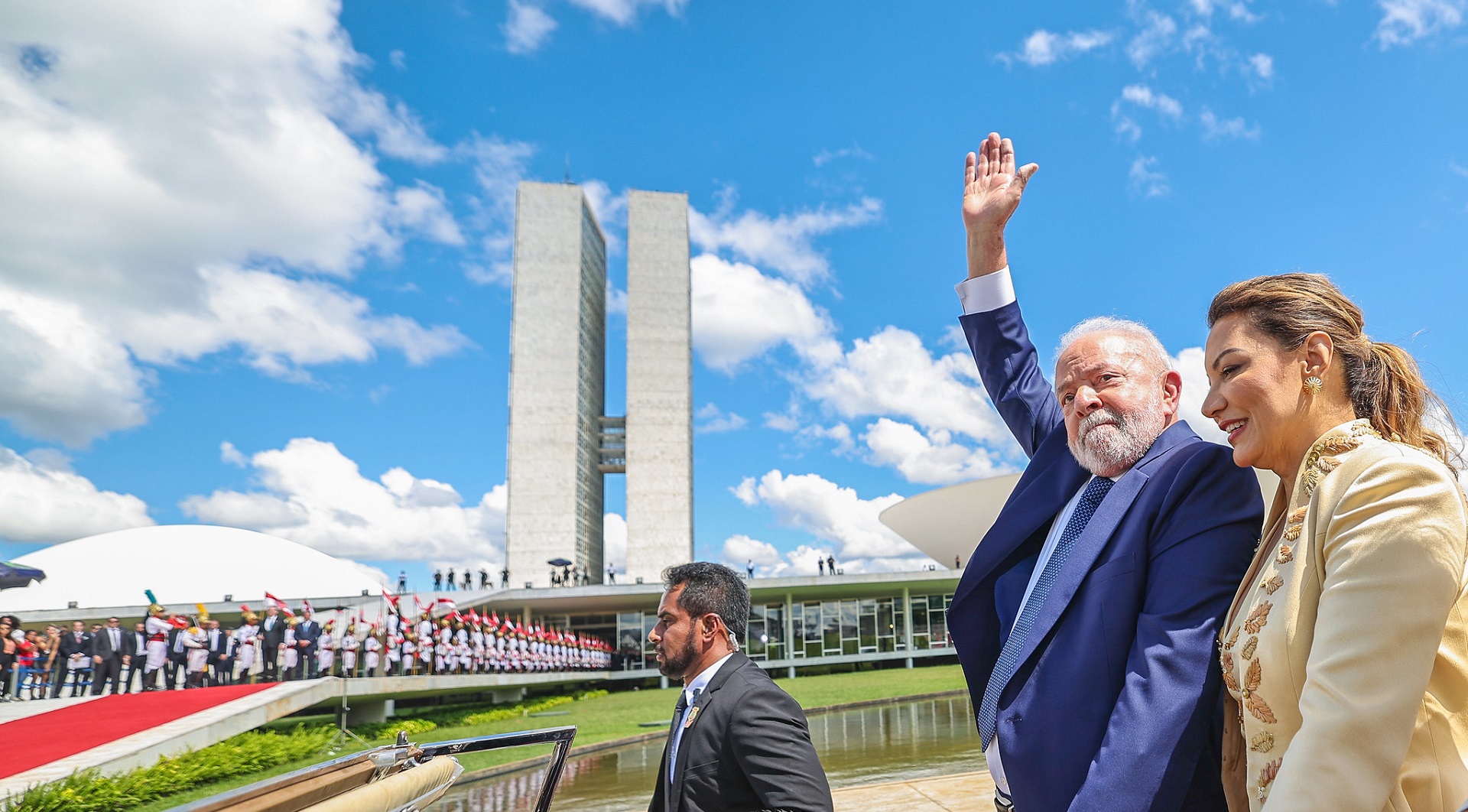
Brasília, January 1, 2023 — presidential inauguration.
- Born
- October 27, 1945, Pernambuco
- Profession
- Lathe operator
- President of Brazil
- 2003–2010 and since 2023
- Party
- Workers' Party (PT)
Origins
Luiz Inácio Lula da Silva was born on October 27, 1945, in Garanhuns, in the semi-arid interior of Pernambuco — in the village of Vargem Comprida, then a district of Garanhuns and now part of the municipality of Caetés. He was the seventh of eight children of Aristides Inácio da Silva and Eurídice Ferreira de Mello, known as Dona Lindu.
His childhood was marked by poverty and drought in Brazil's Northeast, a reality shared by millions of Brazilian families that would help shape his views on hunger and inequality.
Migration
In December 1952, Dona Lindu set off for São Paulo with her children on the back of an open truck — a "pau de arara" — on a journey of about thirteen days, to rejoin her husband, who had migrated earlier. The family first settled on the São Paulo coast and, in 1956, moved to the state capital.
The family's story mirrors that of millions of people from the Northeast who migrated to Brazil's Southeast in search of work and better living conditions.
Education and work
As a child, Lula worked as a shoeshine boy and street vendor to help support the household. At 14, he got his first formal job, at the Armazéns Gerais Columbia warehouses, and completed a lathe operator course at Senai, the national industrial training service.
In 1964, while working at a screw factory, he lost the little finger of his left hand in an accident with a press. Shortly afterwards, he joined the metalworking industry of the ABC region near São Paulo, where he would build his professional and political career.
Union leadership
In 1969, encouraged by his brother José Ferreira da Silva, known as Frei Chico, he joined the board of the Metalworkers' Union of São Bernardo do Campo and Diadema. He was elected president of the union in 1975 and re-elected in 1978.
In the late 1970s, he led the large strikes in the ABC region, which brought together tens of thousands of workers and became a landmark in the reorganization of the labor movement and in the struggle to restore democracy while Brazil was still under military rule.
Founding of the PT
On February 10, 1980, he took part in founding the Workers' Party (PT) in São Paulo, bringing together trade unionists, intellectuals, social movement activists and members of religious communities during Brazil's political opening.
That same year, during a new metalworkers' strike, he was arrested under the National Security Law and held for 31 days at the Dops political police headquarters in São Paulo. In 1982, he ran for office for the first time, for governor of the state of São Paulo.
Democracy and the Constituent Assembly
In 1983, he helped found the Central Única dos Trabalhadores (CUT), Brazil's largest trade union federation. In 1984, he was among the leaders of the Diretas Já campaign, which brought millions of people onto the streets to demand direct presidential elections.
In 1986, he was elected federal deputy for São Paulo to the National Constituent Assembly, receiving more votes than any other candidate in the country. He took part in drafting the 1988 Constitution.
Presidential campaigns
In 1989, in the first direct presidential election after military rule, he reached the runoff and was defeated by Fernando Collor de Mello. He ran for president again in 1994 and 1998, losing both times to Fernando Henrique Cardoso.
During this period, he traveled across the country on the "Citizenship Caravans", seeing first-hand the realities of different Brazilian regions.
First and second terms
Elected president in the 2002 runoff, he took office on January 1, 2003. At the very start of his government he launched the Zero Hunger (Fome Zero) program and, that same year, created Bolsa Família, a cash transfer program that would become an international reference. He was re-elected in 2006.
His eight years in office combined economic growth, real increases in the minimum wage, wider access to credit and the expansion of universities and technical schools. Food security and poverty reduction policies helped Brazil leave the Hunger Map of the Food and Agriculture Organization of the United Nations (FAO) in 2014.
In foreign policy, Brazil expanded its relations with Latin America, Africa, the Arab world and Asia, gained prominence in the G20 and took part in forming the BRICS group. Lula left office in 2010 with high approval ratings.
Between terms
In 2011, he was diagnosed with laryngeal cancer, from which he recovered after treatment. In 2017, he lost his wife, Marisa Letícia, his partner of more than four decades.
In 2018, he was imprisoned in Curitiba after a conviction stemming from the Lava Jato (Car Wash) investigation, and spent 580 days in custody before being released in November 2019. In 2021, Brazil's Supreme Federal Court annulled the convictions, ruling that the 13th Federal Court of Curitiba lacked jurisdiction over the cases, and later recognized that former judge Sergio Moro had acted with bias. Lula's political rights were thereby restored.
In 2022, he married sociologist Rosângela Lula da Silva, known as Janja, and on October 30 he was elected President of Brazil for the third time.
Third term
He took office on January 1, 2023. One week later, on January 8, the buildings of the three branches of government in Brasília were invaded and vandalized; the response of Brazil's institutions reaffirmed the country's commitment to democracy.
In his third term, the government relaunched Bolsa Família and other anti-hunger policies and once again made fighting deforestation in the Amazon a priority. During its G20 presidency, Brazil proposed the Global Alliance Against Hunger and Poverty, launched at the Rio de Janeiro Summit in November 2024 with dozens of countries and organizations joining.
In 2025, the FAO again recorded Brazil's exit from the Hunger Map, and the country hosted the 30th United Nations Climate Change Conference (COP30) in Belém, placing the Amazon at the center of the global climate debate.
Note. Informational biography prepared by the independent Lula for Peace committee from public facts.